

Winging it: peregrine falcons take flight at SUNY Cortland
04/05/2023
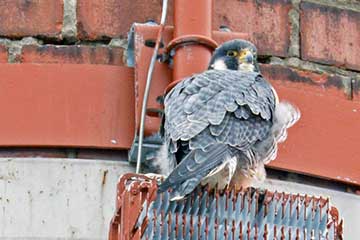
SUNY Cortland’s campus has long attracted some of the nation’s best students, faculty and staff. As of late, it’s drawn in a new group known for being very selective: peregrine falcons.
Peregrines are the fastest birds in the world, reaching speeds of more than 200 miles per hour as they drop from the sky like cruise missiles to snatch their favorite prey – other birds – out of the sky. The crow-sized predators are an endangered species in New York, where widespread use of the pesticide DDT wiped out the Empire State’s population by 1965.
Since they were reintroduced in mid-1970s, the birds have slowly made a comeback. Most of them have established themselves among the peaks of the Adirondack Mountains, in the cliffs and bridges along the Hudson River, and on the ledges of skyscrapers in New York City, according to the New York State Department of Environmental Conservation.
And, for the last several years, at SUNY Cortland.
It’s not that surprising that the peregrines like SUNY Cortland, according to Steven Broyles, a SUNY Distinguished Teaching Professor in the Biological Sciences Department.
“We have had the birds overwinter here in Cortland,” he said of the falcons, which typically fly south as temperatures drop in the fall. “I am guessing that the abundance of pigeons, mourning doves, American crows, and maybe ducks at the Waterworks keep the birds well fed during the winter.”
In 2015, one of the students in Broyles’ Ornithology class first notified him of a peregrine falcon appearance at Casey Tower residence hall. Affectionately named “Casey,” the bird has roosted on the Casey and Smith Towers every winter since then.
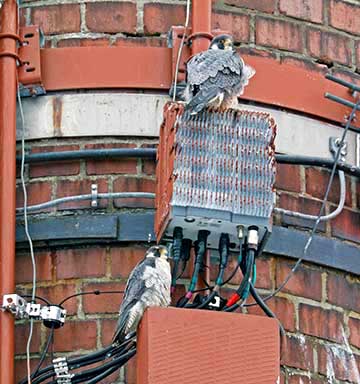
Recently, two more of the birds — possibly a mating pair — were found. Students Emily Faulk and Kaleb Frierson, who are taking Broyles’ Ornithology class, discovered them at the former steam plant smokestack near Bowers Hall and Old Main.
While it’s said that birds of a feather flock together, that’s not so common for peregrine falcons. They mate for life but are otherwise solitary hunters. That’s strong evidence that points to the two falcons being a mating pair.
“One bird was about one-third bigger than the other. Female peregrines are generally one third bigger than males. Peregrines are also territorial and having two birds tolerate one another like this is suggestive of a mating pair. A mating pair in Cortland is very cool.”
Broyles said the number of falcons throughout North America likely dipped to fewer than 700 birds in the 1960s but has now reached between 6,000 to 10,000. New York still hasn’t recovered to its previous levels of peregrine population, making every breeding pair important.
If SUNY Cortland’s two smokestack birds are mating, finding their nesting site may not be easy. Peregrine falcons are known to nest on cliffs, window ledges, rooftops or bridges. But that doesn’t mean they’re not particular.
"My understanding is that they prefer ledges with a little bit of overhead covering,” Broyles said. “The smokestack does not provide that kind of location. ... I have seen a peregrine fly in the downtown area several times. We really need more eyes in the community to report good observations.”
SUNY Cortland’s unused smokestack acts as a high watchtower for the birds during the daytime. Broyles suspects they use it to launch foraging flights.
He recalls a walk several years ago in early spring when a loud sound drew his attention to a cloud of feathers in the air. Following the bird to the Towers, he found a peregrine falcon with its prey. It had struck a mourning dove out of the air, killing it for food.
Whether or not falcon young (or Eyas) are on the way, anyone lucky enough to spot them is in for a treat. It’s a familiar excitement, Broyles says, for students in Ornithology.
“Most field classes are eye-opening to students,” he said. “After ornithology, they hear more and see more movement in nature. Nearly all the 80 to 100 species that they see will be something new and different.”
More News
Yung Gravy will headline Spring Fling

The high-energy rapper will perform at SUNY Cortland on April 29
Campus to celebrate Arbor Day
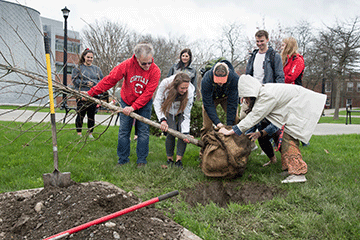
A tree-planting ceremony, scavenger hunt and trivia contest will mark the holiday.
Red Dragon Fest to splash down on May 4
For one donated food item, students can try to dunk an administrator in a pool.
Students set to shine at Transformations
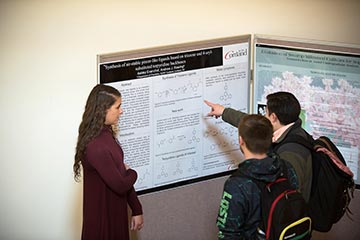
The conference gives student scholars a chance to show the results of academic research.
Blackbird Film Festival returns April 28

The event will bring an international group of movies and filmmakers to Central New York.
The Cortland Challenge is back!
Your support on April 19 could help unlock more than $100,000 in matching gifts for SUNY Cortland and its students.
SUNY Cortland’s first TEDx event set for May 4

Ten speakers from across the country were selected out of 122 applicants.
SUNY Cortland announces Commencement speakers

Three faculty members will speak at ceremonies on May 13.
SUNY Cortland to spotlight labor on April 27

The “Labor Spring” events will include a panel, an academic lecture and a rally.
Campus police add therapy dog to roster
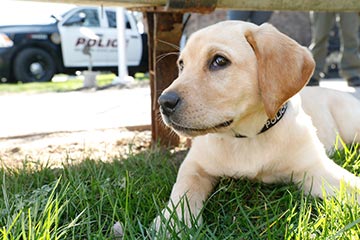
The Labrador Retriever will officially wag her way onto campus this fall.